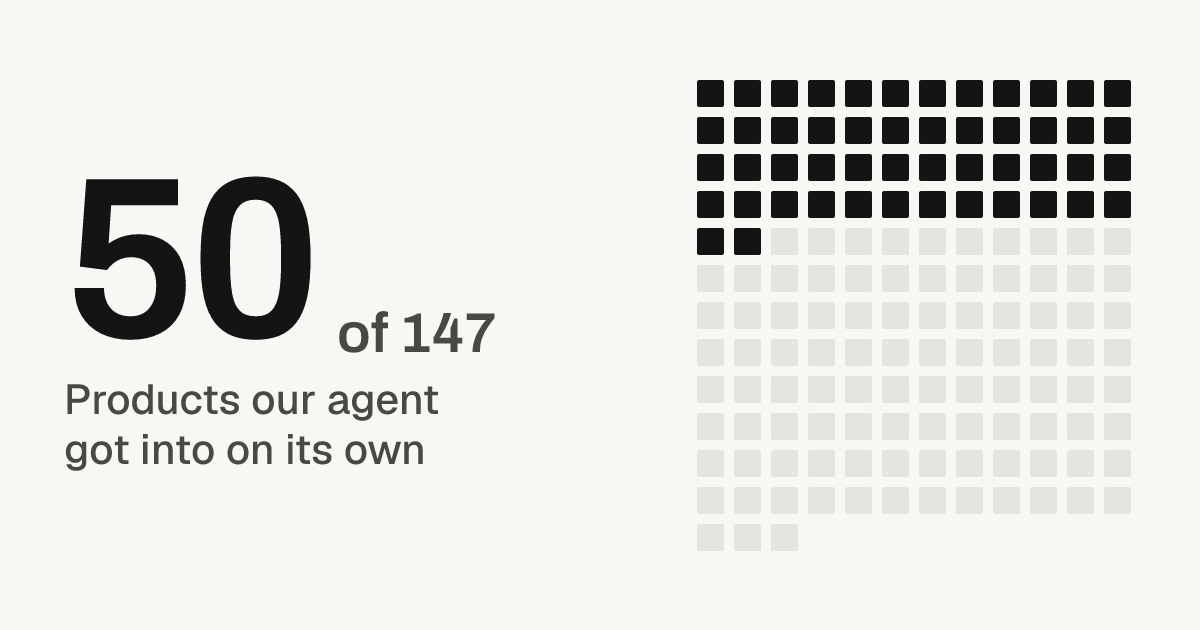
As of 20 October 2026, 0 of 147 products we drove let an AI agent do the whole job alone: learn the product from its docs, get in, do the work, pay and leave, with no person at any step. Our agent got into 50 of 147 products on its own. Agents as customers are early, and the products that let an agent in on its own stand out now.
Needs a person is the biggest group on the level chart
93 of 147 products sit at the level Needs a person. They have an API, CLI or MCP server, but an AI agent can’t get in on its own.
As of 20 Oct 2026: our drives of 147 products, 1–20 Oct 2026 · Today's numbers
Data table
| Products | Out of | Share | |
|---|---|---|---|
| L0 | 4 | 147 | 3% |
| L1 | 93 | 147 | 63% |
| L2 | 10 | 147 | 7% |
| L3 | 14 | 147 | 10% |
| L4 | 26 | 147 | 18% |
| L5 | 0 | 147 | 0% |
An owner whose product needs a person can see on its page which wall to change, with the next step that would move it up. A builder planning unattended work can pass over the products that need a person for now: at each, a person has to sign up, verify or make the key.
Docs already speak to agents, even where the product won’t
Our agent read the docs of 100 of 147 products on its own and could act on them: a getting-started page, the sign-in docs and examples. At another 42, it read the docs alone but found only part of what it needed to start. At five, the docs needed a person or stayed out of reach.
Some docs are written with an agent in mind. AgentMail’s llms.txt opens with the steps for an agent to sign up, and every page is served as Markdown. Steel serves llms.txt with agent instructions and points to its OpenAPI description from a well-known address.
A product can explain itself to an agent and still keep it out. GitHub serves llms.txt, Markdown docs and an OpenAPI description, which our agent fetched without a browser. Its sign-up page showed our agent a DataDome block page, with no challenge to solve.
A builder can point an agent at docs like these today, and check the product’s page for where it stops.
Sign-up is where the door closes
95 of 147 products stopped our agent at sign-up or its verification, before it had a key.
As of 20 Oct 2026: our drives of 147 products, 1–20 Oct 2026 · Today's numbers
Data table
| Checkpoint | Got here with no earlier stop | First stop here |
|---|---|---|
| Docs | 147 | 0 |
| Sign-up | 147 | 92 |
| Verify | 55 | 3 |
| Key | 52 | 2 |
| First call | 50 | 0 |
| First action | 50 | 2 |
| Pay | 48 | 21 |
| Cancel | 27 | 0 |
| Delete | 27 | 9 |
| Through every checkpoint | 18 |
The stops are specific settings. Canva put a Cloudflare managed challenge on its sign-up page that never cleared for our agent’s browser. Dropbox put an Arkose Labs puzzle in front of its sign-up form. Both checks met a signed agent that no bot-check provider yet listed as a verified bot. Notion showed no challenge: its form said a code was on its way, then answered “Signup is not allowed.”
Not every wall is a bot check. Front and Zendesk require a phone number on their sign-up forms, and our agent had none to give. Figma’s robots.txt closes its sign-up page to agents that act for a user, ChatGPT-User and Claude-User among them. Each is a setting an owner can change: make the phone field optional, or drop the rule that names agents.
A check can let our agent through on a drive and stop it on the next, so each product page shows its record over recent drives. The detail, check by check, is in can AI agents sign up.
An open door looks like Cloudinary: a documented call with no account returned a working cloud, its key and a link to claim it. Owners who want that for their own sign-up can start with let AI agents sign up.
Terms can allow only accounts a person makes
The terms of five products say outright that only a person may make an account: Browse AI, GitHub, Steel, Supabase and Umami. At these products an agent can’t make its own account, by the owner’s choice.
In GitHub's Terms of Service, B. Account Terms, 3. Account Requirements:
You must be a human to create an Account. Accounts registered by “bots” or other automated methods are not permitted.
The clause keeps the account for a person, whoever an agent works for. At Steel the clause covers accounts only: its pay-per-call route needs none, and our side paid it (below). For owners who want agent customers, the fix is one sentence in the terms: an agent that acts openly for a named person or company may sign up.
Paying is the step furthest from an agent’s reach
72 of 147 products can only be paid through a card checkout a person completes.
At Postiz and Fathom Analytics, the card comes before anything else: Postiz’s docs say a trial needs a payment method, and Fathom Analytics puts a card field on its sign-up form to start the trial. At Mattermost, a person has to buy: the workspace’s subscription page says to contact sales to continue after the trial ends. The owner’s step is to start a trial without a card, and to let a plan be bought after it without a call to sales.
Our side made and checked an agent-native payment, over x402 or MPP on the product’s own endpoint or a host its docs name, at five products: Apify, Browserbase, Exa, Parallel and Steel.
Apify sold a token over x402 on agi.apify.com that runs any Actor. Browserbase sells browser sessions, search and fetch per call, while its plans sit in a dashboard behind a sign-up that asks for a phone number. Exa takes x402 per call for search and page contents; answers, agent runs, websets and monitors need a key. Parallel runs its gateway on parallelmpp.dev, named in its own docs, for search, extract, responses and tasks. Steel sells scrape, screenshot and PDF per call, with no account.
No product among them yet lets an agent finish the whole job alone. For owners with a rail, the next step is to sell credits or the plan over it, not only per-call use. A builder with a wallet can pay these products per call today.
Where an agent can already work on its own today
26 of 147 products are at L4 Runs on its own: our agent got in on its own, did the bulk of the core work and could stop paying without a person. They are AgentMail, Airtable, Anchor Browser, Attio, Browserless, Buttondown, ClickHouse Cloud, Cloudinary, Convex, Craft, DocuSeal, Fillout, Firecrawl, Formbricks, monday.com, Nifty, NocoDB, Parallel, Penpot, Pipedream, Pipedrive, Plane, Shortcut, Tally, Twenty and Zulip.
 On recordAgentMailEmail infrastructureL4Runs on its own
AgentMail gave our agent an account, an inbox and an API key from a sign-up call, with the code checked by API. Convex needed no account: a documented route got our agent working without one. Anchor Browser hands out an API key through its documented Agent Access flow, also with no account. Firecrawl let our agent in with Sign in with AgentID, an identity our agent made through AgentMail’s API, then a click in its browser. Craft took our agent through an email sign-up in its browser, where an invisible reCAPTCHA let it through.
 On recordCraftDocs and workspaceL4Runs on its own
For owners, the steps that move a product up: let agents in at sign-up without a puzzle or a phone number, give a key by API, and take a payment over HTTP 402. The free check shows the wall an agent would likely hit at your product, and fixes lists the changes. For builders, the October report goes product by product.