Sign-up decides: llms.txt, OpenAPI and MCP don't get an AI agent in
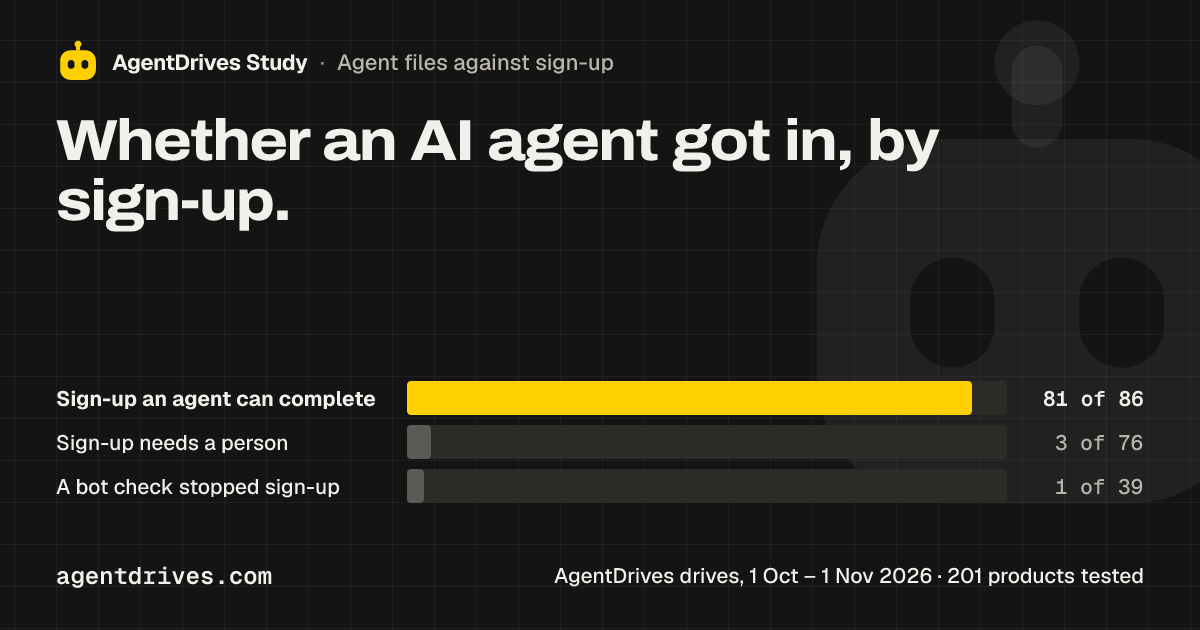
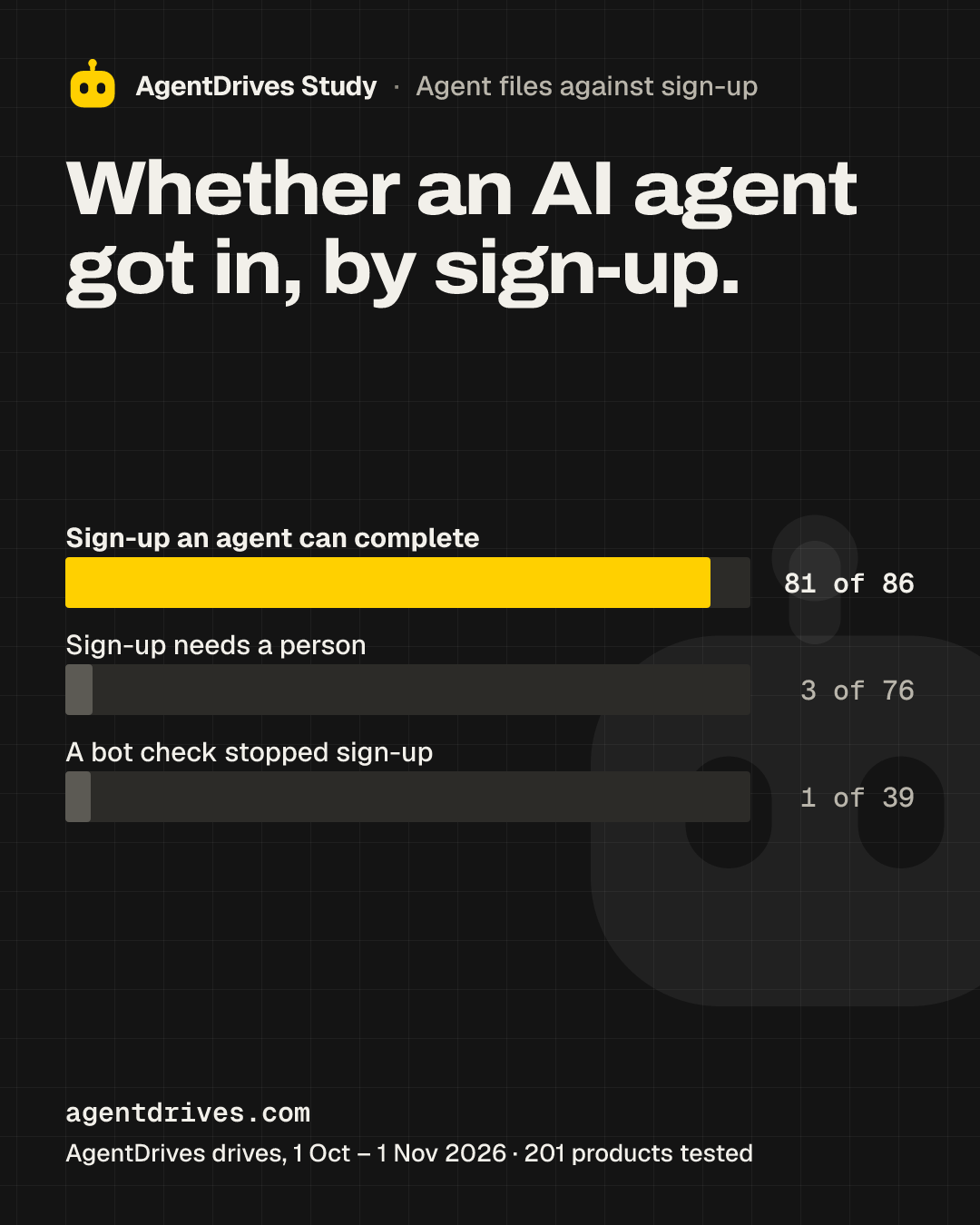
81 of 86 products with a sign-up an agent can complete let our agent in (94%), against 4 of 115 where sign-up needed a person or a bot check stopped it (3%). With the sign-up held equal, no file for agents moved that by more than 6 points.
The three numbers.
94% vs 3%Got in with a sign-up an agent can complete (81 of 86), and without one (4 of 115)
6 pointsThe most llms.txt, llms-full.txt, OpenAPI, MCP, a CLI or Markdown docs moved the got-in rate, sign-up held equal
63% vs 15%Finished core tasks that went through the API (308 of 487), and through MCP (73)
What we found.
| Sign-up | Products | Got in | First working call |
|---|---|---|---|
| An agent can complete it | 86 | 94% (81 of 86) | 93% (80 of 86) |
| Needs a person | 76 | 4% (3 of 76) | 13% (10 of 76) |
| A bot check stopped it | 39 | 3% (1 of 39) | 18% (7 of 39) |
| File | Products with / without | Got in, with / without | Core tasks done, with / without | Difference in got in, all products |
|---|---|---|---|---|
| llms.txt | 77 / 9 | 95% / 89% | 68% / 85% | +0.3 points |
| llms-full.txt | 30 / 33 | 100% / 91% | 68% / 64% | +3.5 points |
| OpenAPI | 55 / 31 | 98% / 87% | 69% / 72% | +4.7 points |
| MCP server | 77 / 9 | 95% / 89% | 70% / 75% | +4.1 points |
| CLI | 47 / 39 | 98% / 90% | 68% / 73% | +5.6 points |
| Markdown docs | 49 / 9 | 98% / 89% | 66% / 84% | -1.8 points |
- Across every product, with sign-up kind and product family held equal, the difference in the share our agent got into ran from -2 to +6 points for every file.
- The largest was a CLI, +5.6 points (p 0.15).
- Within the 86 products with a sign-up an agent can complete, between 87% and 100% got in, with or without each file.
- Products with llms-full.txt saw more of their core work done: 68% against 64%, with the same open sign-up. It is the one file that leans positive, a lean and not a rule.
- Files for agents are common: llms.txt on 168 of 201, an MCP server on 174 of 201, OpenAPI on 103 of 201, docs served as Markdown on 81 of 111, a CLI on 96 of 201, llms-full.txt on 58 of 150.
What did the work.
The API did most of the finished work: 308 of 487 core tasks (63%) across 75 products, against 73 through MCP (15%).
| Route | Core tasks finished | Share | First working calls | Share |
|---|---|---|---|---|
| The API | 308 | 63% | 78 | 82% |
| The web app | 62 | 13% | 3 | 3% |
| MCP | 73 | 15% | 8 | 8% |
| A CLI | 21 | 4% | 5 | 5% |
| An SDK | 23 | 5% | 1 | 1% |
What to do.
For product owners
- Fix the sign-up first: a path an agent can finish on its own, then a key it can create without a person.
- Keep llms.txt, OpenAPI and an MCP server. They help an agent read your product once it is in. They don't let it in.
- If you publish llms.txt, add llms-full.txt beside it.
For agent builders
- Check the sign-up before you pick a product for an agent. An llms.txt or an MCP server says little about whether your agent gets in.
- Plan on the API for the work. MCP did a small share of the finished tasks.
- Get an API key early: the first working call went through the API at 78 of 95 products.
Method and limits.
How we tested
- 201 products, the newest drive of each, 1 Oct 2026 to 1 Nov 2026. One agent drove each product on its own, over HTTP, a CLI, MCP and a browser.
- Got in: our agent had a working account or key. First working call: an API, CLI or MCP call that answered. Core tasks done: the share of the product's core tasks finished and read back, on the products it got into.
- Files as each drive found them; llms-full.txt from a read of 150 products' sites; Markdown docs from asking 111 products' docs pages for Markdown on 26 Oct 2026.
- Each difference holds the sign-up kind (an agent can complete it, it needs a person, a bot check stopped it) and the product family (developer infrastructure or business app) equal: a weighted mean of the differences within each group. A shuffle test (4,000 shuffles within each group) gives its p.
Limits
- A cell shows only when both sides have 5 or more products.
- This compares products as they are, not one product with and without a file. A file may mark products that differ in other ways.
- Few products lack llms.txt or an MCP server, so the "without" side is small for those two: 33 without llms.txt and 27 without an MCP server.
- The llms-full.txt lean may only mean those products had fuller docs to begin with.
- Files may still change how an agent reads a product in ways this does not measure: the tokens it spends, the pages it reads, how often it guesses.
Cite this
AgentDrives, “Sign-up decides: llms.txt, OpenAPI and MCP don't get an AI agent in”, 1 November 2026, https:// agentdrives.com/ findings/ agent- files- vs- sign- up.
@misc{agentdrives_agent_files_vs_sign_up_2026,
  author = {{AgentDrives}},
  title = {Sign-up decides: llms.txt, OpenAPI and MCP don't get an AI agent in},
  year = {2026},
  month = nov,
  url = {https://agentdrives.com/findings/agent-files-vs-sign-up},
  note = {Agent test drive, CC BY 4.0},
}
CC BY 4.0, with credit
See what an agent sees in yours.
Free: what an agent finds, any wall in its way and how many things to fix. The Audit ($499) gives you every fix.