Content Signals and AI rules in SaaS robots.txt
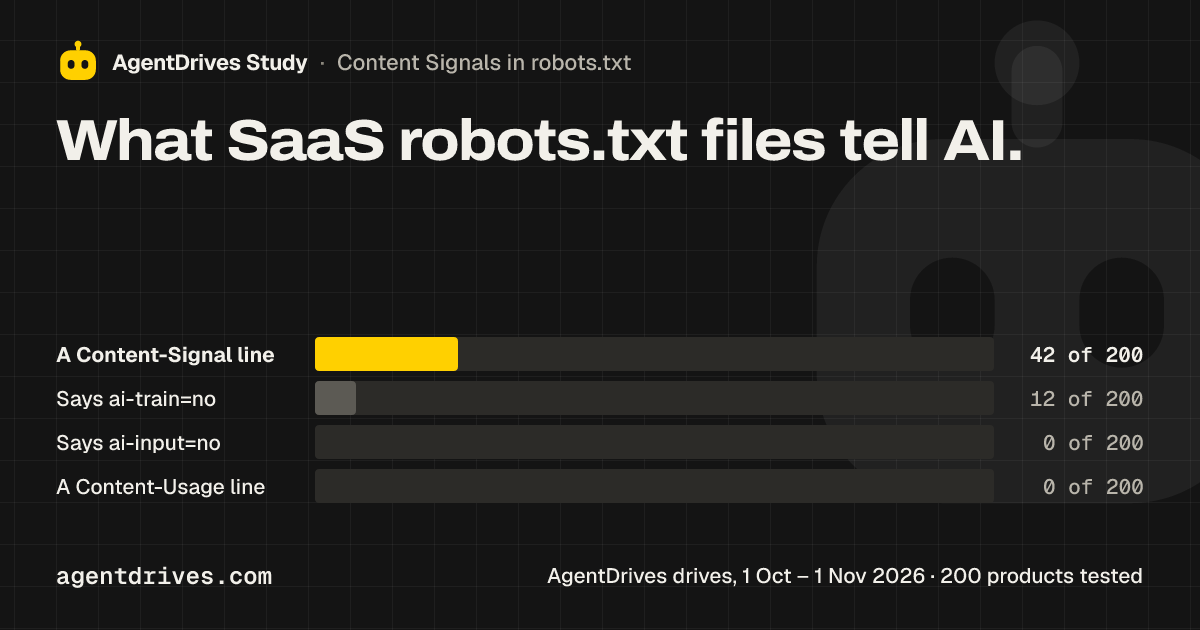
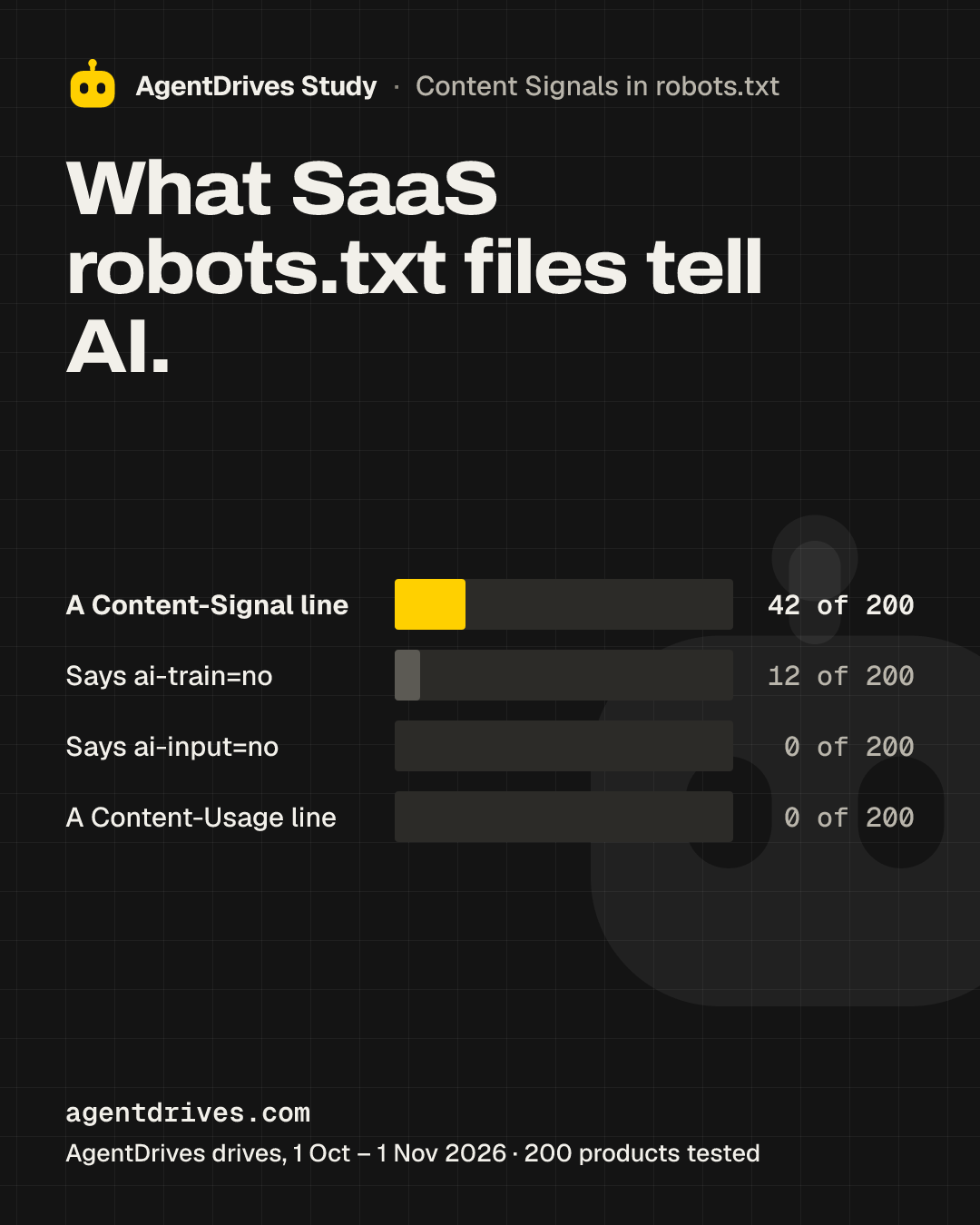
42 of the 200 SaaS products we checked (21%) tell AI what it may do with their content in robots.txt, all with Cloudflare's Content-Signal line. None uses the IETF's Content-Usage line.
Two lines for AI preferences
Content-Signal- Cloudflare's line. Each label is yes or no.
searchbuilding a search indexai-inputfeeding content into AI models for real-time answersai-traintraining or fine-tuning AI models
Content-Usage- The IETF's draft, vocab-08. Labels train-ai, ai-use, search, each y or n.
Content-signal: search=yes, ai-train=no, use=reference
What we found.
12 of the 42 Content-Signal lines say no to AI training (ai-train=no), and 30 say yes. 0 of the 42 say no to using the content in AI answers (ai-input=no). All 42 say yes to search. At 20 of 201 products, robots.txt closes the sign-up page to AI agents.
| Label | Yes | No | Not said |
|---|---|---|---|
| search | 42 | 0 | 0 |
| ai-input | 40 | 0 | 2 |
| ai-train | 30 | 12 | 0 |
For agent builders.
- Read Content-Signal and Content-Usage lines when you read robots.txt. They sit beside Allow and Disallow, not in place of them.
- Allow and Disallow still decide what you may fetch. The preference lines say what the owner wants done with what you fetched.
- ai-input is the label for an agent that reads a page to answer a question. Check it before you quote or summarise a page.
- The two lines use different labels: ai-train and ai-input in Content-Signal, train-ai and ai-use in Content-Usage. Don't mix them.
Method and limits.
How we tested
- Drives from 1 Oct to 1 Nov 2026, 201 products.
- At 200 of them, the drive read the robots.txt at the product's own domain.
- A product counts when a Content-Signal or Content-Usage line appears in that file.
Limits
- Each product as it was on the day of its newest drive.
- Only the product's own domain. A docs or app host can carry a different robots.txt.
- We read the start of each file, so a line far down a long file can be missed.
Cite this
AgentDrives, “Content Signals and AI rules in SaaS robots.txt”, 1 November 2026, https:// agentdrives.com/ findings/ content- signals.
@misc{agentdrives_content_signals_2026,
  author = {{AgentDrives}},
  title = {Content Signals and AI rules in SaaS robots.txt},
  year = {2026},
  month = nov,
  url = {https://agentdrives.com/findings/content-signals},
  note = {Agent test drive, CC BY 4.0},
}
CC BY 4.0, with credit
See what an agent sees in yours.
Free: what an agent finds, any wall in its way and how many things to fix. The Audit ($499) gives you every fix.