MCP sign-in: which servers let an AI agent register itself?
An AI agent can register itself as a client at 55 of the 59 MCP servers whose sign-in we read. At 33 of them, the only way is dynamic client registration (DCR), which the MCP spec deprecated in its 2026-07-28 version.
What we found.
| Of 79 MCP servers | Servers | Share |
|---|---|---|
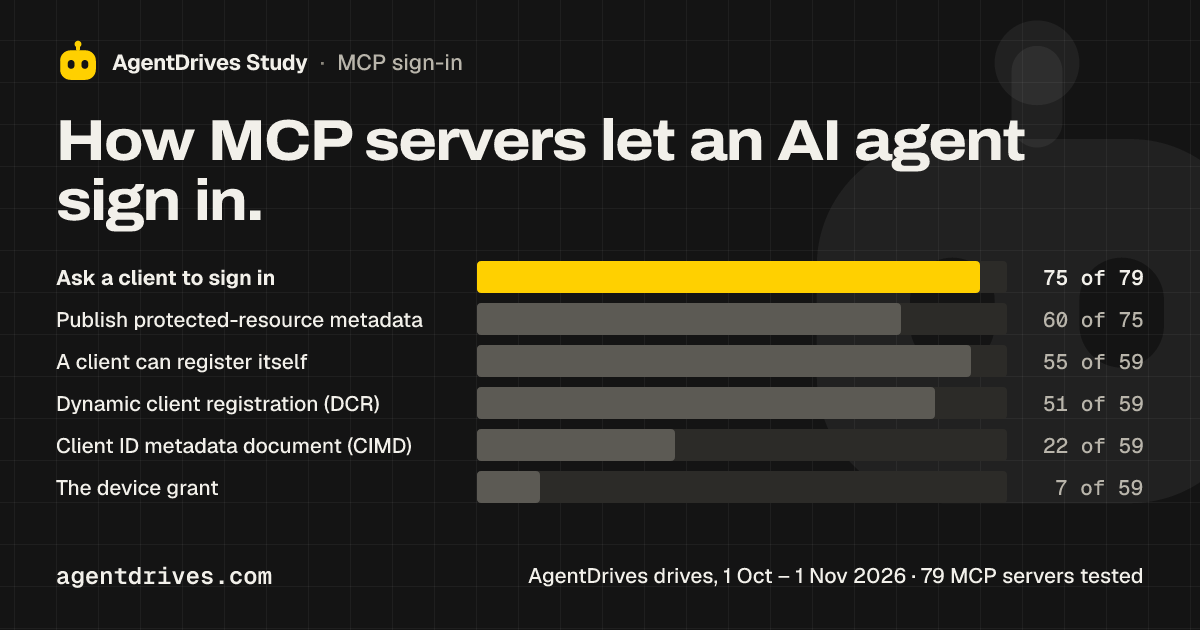
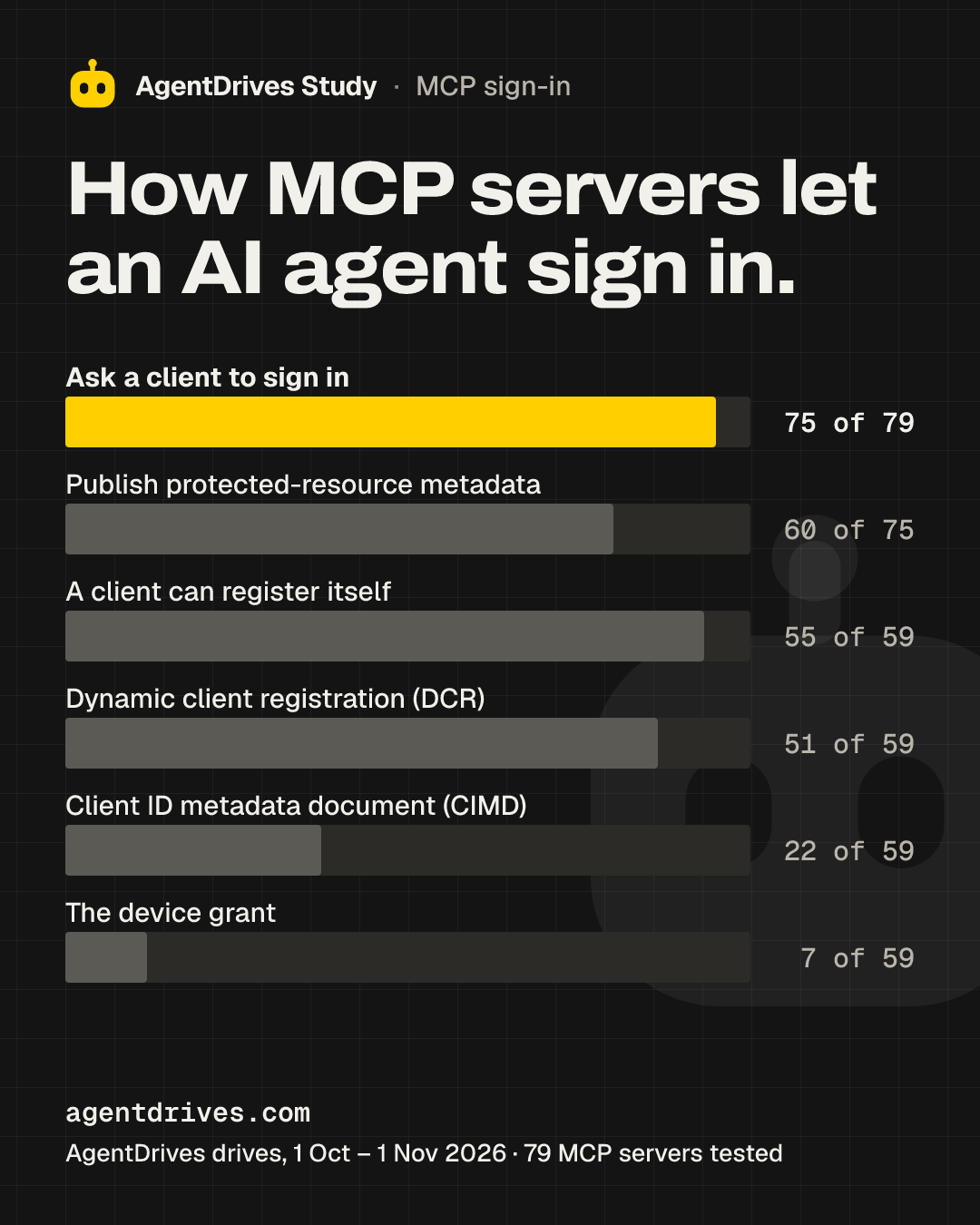
| Ask a client to sign in | 75 of 79 | 95% |
| Publish protected-resource metadata | 60 of 75 | 80% |
| Publish authorization server metadata | 59 of 75 | 79% |
| Of 59 sign-ins read | Servers | Share |
|---|---|---|
| A client can register itself | 55 of 59 | 93% |
| Dynamic client registration (DCR) | 51 of 59 | 86% |
| Client ID metadata document (CIMD) | 22 of 59 | 37% |
| Both | 18 of 59 | 31% |
| DCR only | 33 of 59 | 56% |
| Neither: register beforehand | under 5 | |
| The device grant | 7 of 59 | 12% |
- 75 of the 79 MCP servers we found ask a client to sign in. 60 of those publish protected-resource metadata, which the spec requires.
- 22 accept a client ID metadata document (CIMD), the way the spec now recommends. 18 of those offer DCR too.
- 7 offer the device grant: a person approves the sign-in on another screen while the agent waits for its token.
- At 16 of the 75 sign-ins, the authorization server published no metadata at the standard addresses, so a client has no standard way to learn how to register.
What to do.
For product owners
- Publish protected-resource metadata for your MCP server, so a client can find where to sign in.
- Accept a client ID metadata document at your authorization server. Keep DCR next to it while clients move over.
- Offer the device grant, so an agent without a browser can get a token a person approves.
For agent builders
- Read the server's protected-resource metadata first. It names the authorization server.
- Support both CIMD and DCR in your client. 33 of the 59 servers still offer only DCR.
Method and limits.
How we tested
- Drives from 1 Oct 2026 to 1 Nov 2026, 201 products. At 79 of them we found the product's MCP server and read how it lets a client sign in.
- We call the server without a token, read the 401's Bearer challenge and the protected-resource metadata (RFC 9728), then the authorization server's metadata (RFC 8414, else OpenID configuration).
- A server lets a client register itself when that metadata lists a registration endpoint (DCR) or says it accepts a client ID metadata document (CIMD).
Limits
- Each server as it was on the day of its drive.
- Public metadata only. These counts don't need a finished sign-in.
- A product counts once one of its drives read its MCP server's sign-in.
- Counts under 5 are left out.
Sources
Counted 1 Nov 2026.
Cite this
AgentDrives, “MCP sign-in: which servers let an AI agent register itself?”, 1 November 2026, https:// agentdrives.com/ findings/ mcp- sign- in.
@misc{agentdrives_mcp_sign_in_2026,
  author = {{AgentDrives}},
  title = {MCP sign-in: which servers let an AI agent register itself?},
  year = {2026},
  month = nov,
  url = {https://agentdrives.com/findings/mcp-sign-in},
  note = {Agent test drive, CC BY 4.0},
}
CC BY 4.0, with credit
See what an agent sees in yours.
Free: what an agent finds, any wall in its way and how many things to fix. The Audit ($499) gives you every fix.