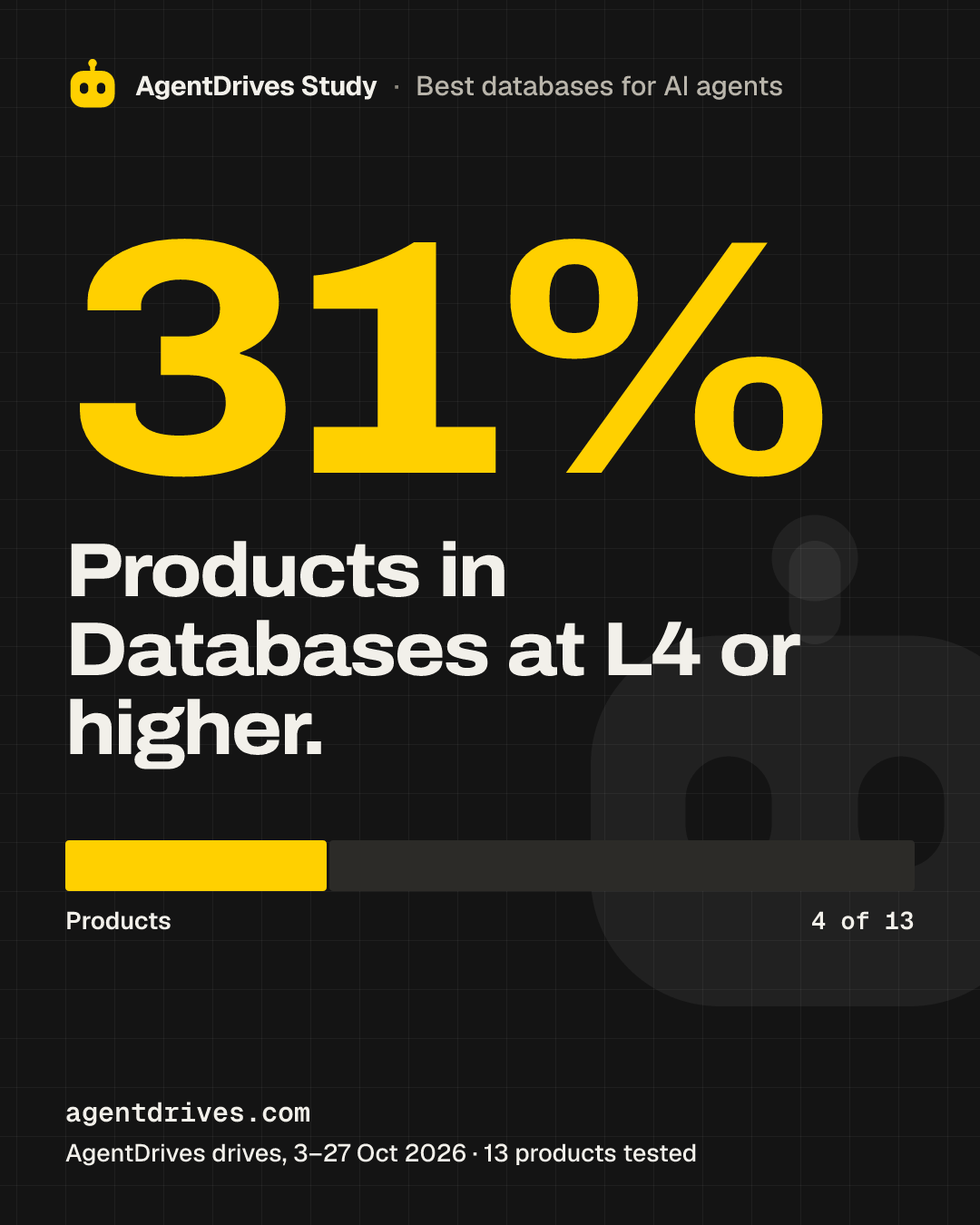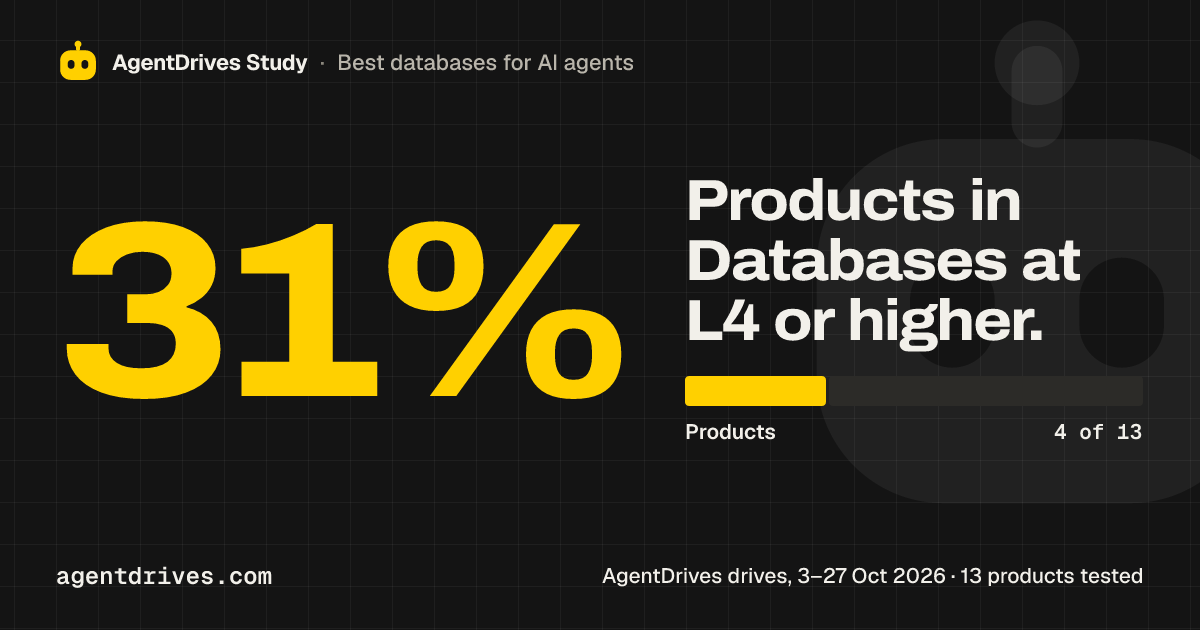
4 of 13 databases took our agent all the way to L4 Runs on its own: Upstash, Airtable, Convex and NocoDB. In each it got in without a person and did every core task. 6 of 13 stopped it at sign-up, before any database work.
No database let it pay on its own: 0 of 13. That is the step between every L4 here and L5.
The ranking: 13 databases by how far our agent got
Upstash ranks first: it handed our agent a working Redis database in a minute, with no account. The order is the same as on Databases.
| Database | Where it stopped | Level | Got in | Core work |
|---|---|---|---|---|
| 1. Upstash | Checkout: $0.20 a call | L4 | No account, 1 min | 6 of 6 |
| 2. Airtable | Checkout: $24 a month | L4 | Sign-up, 4 min | 10 of 10 |
| 3. Convex | Pay: needs an account | L4 | Local, 3 min | 10 of 10 |
| 4. NocoDB | Checkout: card form | L4 | Sign-up, 7 min | 10 of 10 |
| 5. Firebase | Pay: needs an account | L3 | Local, 6 min | 7 of 10 |
| 6. Neon | Pay: not reached | L3 | No account, 3 min | 5 of 10 |
| 7. PlanetScale | Card first: $5 a month | L2 | Sign-up, 4 min | Not measured |
| 8= Appwrite | Sign-up: robots.txt | L1 | No | None |
| 8= Baserow | Sign-up: Turnstile | L1 | No | None |
| 8= CockroachDB | Sign-up: reCAPTCHA | L1 | No | None |
| 8= MongoDB Atlas | Sign-up: form refused it | L1 | No | None |
| 8= Supabase | Sign-up: hCaptcha | L1 | No | None |
| 8= Turso | Sign-up: Turnstile | L1 | No | None |
Levels: L4 Runs on its own, L3 Does the work, L2 Gets in, L1 Needs a person. How we ranked: by level, then the share of core work done, then the time to the first call (how we order lists). The six that stopped at sign-up did no database work, so they share 8th place, in name order. Turnstile is Cloudflare’s bot check. Prices are the ones our agent met at checkout. Each row is the newest drive on record by 27 Oct 2026.
Verdicts, database by database
Upstash: best for Redis an agent starts by itself. With no account, the start-redis response carried the endpoint, a REST token and a Redis URL, and our agent ran SET, GET and INCR. With an account, MCP sign-in carried all 6 core tasks.
Airtable: best for records a person also reads. Sign-up in a browser, then all 10 core tasks: databases, records, automations, webhooks and forms.
Convex: best for a full app backend with no account. It ran locally with no login or deploy key: database, functions, live updates, file storage and user login all worked, 10 of 10.
NocoDB: best for a spreadsheet database on a free plan. Our agent signed up in a browser, got a key and did all 10 core tasks.
Firebase: best for local development. Its local emulator ran 7 of 10 core tasks with no account. A live project needs a Google account, whose sign-up asks for a birthday and gender our agent doesn’t have.
Neon: best for throwaway Postgres an agent provisions before a person exists. A free database in 3 minutes, no account, then SQL, user sign-up and reads and writes: 5 of 10 core tasks.
PlanetScale: gets an agent in, then asks for a card. Our agent signed up, confirmed its email, logged in the CLI and got API keys on its own. Every database needs a card on file and there is no free trial, so no database work happened.
Sign-up stopped our agent at six of them
At 6 of 13 databases, sign-up was the first step our agent couldn’t pass on its own. Five of those six stopped it with a bot check on the form; at Appwrite, its robots.txt closes sign-up to AI agents, and our agent keeps to robots.txt.
A bot check stopped our signed agent on at least one way in at 7 of 13. At Convex and Neon it got in another way: a local backend and a claimable database.
Four of the six ran anyway as open-source or downloadable editions with no account: Supabase, MongoDB, CockroachDB and Turso. The level is the hosted product’s.
Paying and leaving
Payment was the first step our agent couldn’t pass at 6 of 13, all four L4s among them. Upstash, Airtable and NocoDB stopped it at the checkout. Convex and Firebase take payment only from an account, and at Neon it didn’t get that far. PlanetScale asked $5 a month before it would make any database.
Leaving went better: an agent could leave on its own at 8 of 13, with no plan to cancel. At Upstash, deleting the account itself took the console in a browser.
What the docs offer agents
Most of these vendors document a route made for agents. We read each page on 29 Oct 2026.
| Database | Documented route | What it needs |
|---|---|---|
| Neon[1] | Claimable Postgres | No account; a person claims it within 72 hours |
| Convex[2] | CLI agent mode | No Convex login or deploy key |
| PlanetScale[3] | Hosted MCP server | OAuth, or a service token sent in a header |
| Firebase[4] | Local MCP server | The Firebase CLI’s credentials |
| MongoDB[5] | Local MCP server | Service account credentials for the Atlas tools |
| Supabase[6] | Hosted MCP server | A browser sign-in to a Supabase account |
| Turso[7] | Platform API | Tokens issued programmatically |
| Upstash[8] | Developer API, CLI and MCP server | An API key made in the console |
Neon puts the idea in one line: “If an agent needs a Neon account and the user is not around, it provisions a project now.”
What a database owner can change
- Let an agent start before a person. Upstash, Convex and Neon got our agent working with no account, and all three reached L3 or higher.
- Take the bot check off sign-up, or offer a second door. At five of the six that stopped our agent, a bot check on the form was the wall.
- Issue keys over an API. Upstash’s Developer API key is made only in the console. Turso’s Platform API manages tokens in code, and PlanetScale’s MCP server also takes service tokens sent in a header.
- Accept a payment an agent can make. Every L4 here stopped at payment.
How we measured
One real agent drove each of 13 databases between 3 and 27 Oct 2026, its newest drive per product. It read the docs, signed up, verified, got a key, made a first call, did the product’s core tasks, tried to pay, cancelled and deleted. A step only counts when our agent did it on its own. Levels and the order follow our method. The documented routes come from vendor pages read on 29 Oct 2026.
Sources
Our drive records, one page per database: Upstash (driven 26 Oct 2026), Airtable (15 Oct), Convex (19 Oct), NocoDB (3 Oct), Firebase (20 Oct), Neon (19 Oct), PlanetScale (22 Oct), Appwrite (27 Oct), Baserow (26 Oct), CockroachDB (27 Oct), MongoDB Atlas (26 Oct), Supabase (27 Oct), Turso (6 Oct). All 13 side by side: Databases.
Vendor pages, each read on 29 Oct 2026: Neon claimable Postgres[1], Convex CLI agent mode[2], PlanetScale MCP server[3], Firebase MCP server[4], MongoDB MCP server[5], Supabase MCP[6], Turso Platform API[7], Upstash Developer API[8].